Ingredients
Terpenes in skincare: aroma, research and skin tolerance
What terpenes are, why they appear in botanical fragrances, and why natural aroma is not a guarantee of gentleness or synergy.
CANNAEAST Editorial · Published 12 November 2026 · Updated 12 November 2026 · 5 min read
Short answer
Terpenes are a diverse family of plant compounds; many familiar volatile terpenes contribute to aroma. Cosmetic roles and skin tolerance depend on the specific substance and concentration. The manufacturer confirms terpenes in our fullspectrum hemp flower and aerial-part extract, but no individual terpene profile or concentrations are stated.
A plant aroma has chemistry behind it
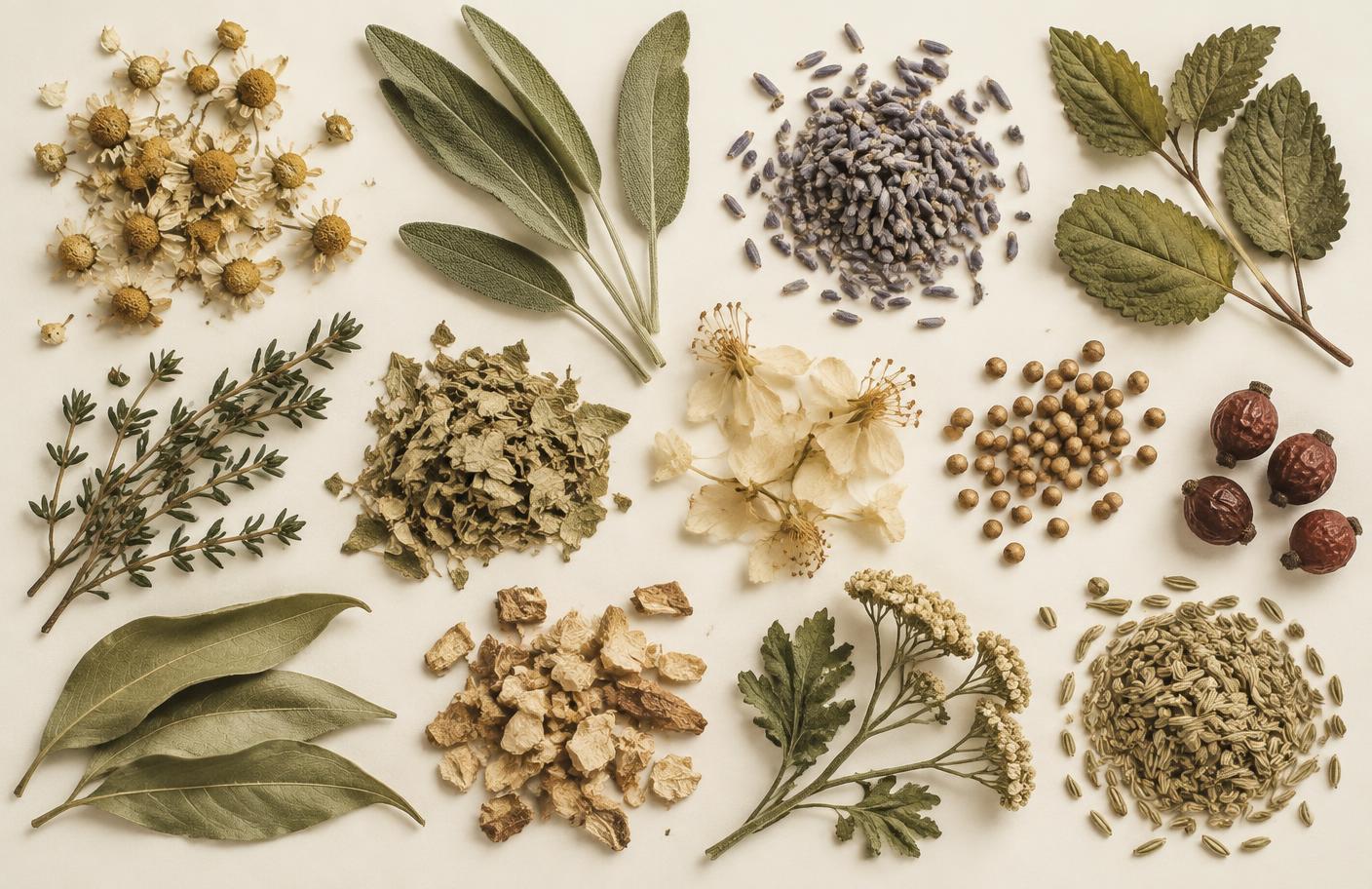
Terpenes occur throughout the plant world, not just in cannabis. Familiar examples include limonene and pinene; linalool is an oxygen-containing terpenoid often discussed alongside them. These volatile compounds can contribute citrus, pine or floral notes to complex plant aromas.
Essential oils are mixtures rather than single ingredients with one predictable effect. A critical review by Sarkic and Stappen describes variation with plant material and extraction, together with skin-safety considerations.
Sources and research:[1]
A pleasant aroma is different from a proven skin benefit
A fragrance can be part of a product's sensory experience. Laboratory studies of individual plant compounds also investigate biological activity. These are different statements: enjoying a scent is not evidence that it treats stress, inflammation or a skin disorder.
A result for a purified terpene cannot be applied to an unspecified essential oil or a finished cream without knowing its composition, dose, formulation and the relevant human evidence.
Sources and research:[1]
What about the entourage effect?
Terpenes and cannabinoids are sometimes marketed as an automatically superior combination. In receptor experiments, Finlay and colleagues found no supporting evidence for the tested terpenes acting as proposed at cannabinoid receptors. This is a mechanistic result with defined limits, not a clinical comparison of skincare products.
The responsible conclusion is not that all interactions are impossible, but that synergy needs to be demonstrated rather than assumed. No evidence supplied to us establishes a terpene–cannabinoid synergy in our cosmetics.
Sources and research:[2]
Natural fragrance can still cause a reaction
The 2024 review by Sukakul and colleagues explains that fragrance substances can cause contact sensitisation. In particular, limonene and linalool can oxidise in air into hydroperoxides that are relevant contact allergens. 'Natural' and 'allergen-free' are not equivalent.
Keep products closed and follow their storage and period-after-opening instructions. A cautious first use on a small area is not a diagnostic allergy patch test and cannot guarantee future tolerance. If you have a known fragrance allergy, ask a dermatologist about suitable products and stop using anything that irritates your skin.
Sources and research:[3]
What our ingredient lists actually say
The supplied face-cream INCI declares Melaleuca Alternifolia (Tea Tree) Leaf Oil and Parfum/Fragrance. Fragrance is also declared in the other supplied formulas. These names do not provide a measured terpene profile or establish the presence of limonene, linalool or beta-caryophyllene in a particular product.
The manufacturer confirms that our products contain fullspectrum hemp flower and aerial-part extract with CBD, other cannabinoids and terpenes. This does not identify individual terpenes, their concentrations or a proven skin benefit of the finished products. Use the current product packaging and complete INCI to check the declared ingredients.
Sources and research
Research cited in this article. Study findings apply to the materials and conditions investigated, not automatically to CANNAEAST products.
- [1] Sarkic & Stappen — Essential Oils and Their Single Compounds in Cosmetics: A Critical Review (2018)
Critical review of essential-oil composition and skin-safety considerations.
- [2] Finlay et al. — Terpenoids From Cannabis Do Not Mediate an Entourage Effect by Acting at Cannabinoid Receptors (2020)
Receptor experiments; no support for the proposed interactions in the tested conditions, not proof about every possible mechanism.
- [3] Sukakul, Bruze & Svedman — Fragrance Contact Allergy: A Review Focusing on Patch Testing (2024)
Clinical review of fragrance sensitisation, including oxidised fragrance terpenes.
Frequently asked questions
Related ingredients

Botanical Extracts
Concentrated plant materials obtained by pressing, soaking or distilling parts of a plant.
Related tutorials
Labels · 5 min
How to read an ingredient list
A five-minute method for making sense of any INCI list on a shelf.
Continue learning
CBD
Cannabinoids in a cream: why the complete formula matters
CBD, hemp extract and a rich cosmetic base do different jobs. A practical guide to understanding them without assuming more means better.
5 min read
Ingredients
Understanding botanical ingredients
The pillar guide to plant ingredients in body care: what an extract is, and how to make sense of an INCI list.
6 min read
Product Guides
How to read a product label
Five things worth checking before you buy anything topical.
5 min read